In 1911, the Louvre was robbed for the first time by an Italian patriot who intended to return the Mona Lisa to his homeland. He skillfully took the prized painting off of its mount, stashed it away in his smock and briskly walked past a security guard. This cemented the popularity of the painting and raised concerns about security effectiveness in art museums worldwide, leaving the former fortress in disgrace. The Louvre responded after the painting’s return years later by increasing competency and number of security, creating strong physical protections, and improving surveillance of both the inventory of paintings and visitor actions. While that was a century ago and multiple heists followed, many of the same questions about security are being raised again following the recent robbery.
What Happened?
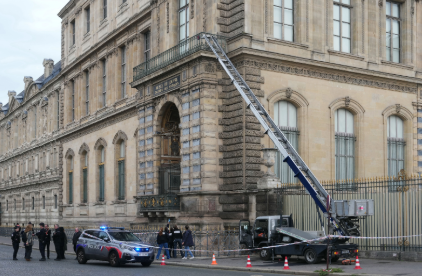
Soon after the museum opened on October 19, 2025, around 9:30, the thieves, who were disguised as renovation workers, used a basket lift to rise to the Apollo Gallery, hastily breaking into a window. Around four minutes later, they entered through the gallery’s south end, setting off the alarm. Around 9:35, the thieves used disc cutters to easily cut through display cases and began stealing artifacts. Finally, around 9:38 the thieves fled the scene with two others waiting on scooters. They escaped with an estimated 102 million dollars worth of priceless crown jewels from French royalty, including precious gems like diamonds, emeralds, and sapphires.
Many security actions occurred within these eight minutes, including a call to the command center by security, a call to the Parisian police and a hurried attempt to close all museum doors. However, the actions were too little, too late, and failed to prove the museum security’s legitimacy after years of decline.
Flaws in Security
This heist, which left the world in disbelief, highlighted the depth of flaws and ineffectiveness in the Louvre’s security. According to NPR, more than half of the highly visited rooms had no security measures at all. The alarm, which was supposed to alert the staff as soon as the thieves broke in, only rang as the perpetrators were leaving. The last major renovation was also in the 1980s, showing that equipment has been aging and no longer meets modern security demands.
Furthermore, there was meager security on the balcony the burglars used to climb into the Apollo Gallery. According to the museum director, Laurence des Cars, “Unfortunately, on the Apollo Gallery side, the only camera installed faces west and therefore does not cover the balcony affected by the break-in.” This emphasizes how lack of focus on a key area culminated in a loss of precious cultural and historical artifacts.
In addition, the efficacy of security has long been a problem, since they are simply not built to handle the Louvre’s crowds with current working conditions. Months prior, on June 16, 2025, the security staff striked for many hours due to shortages. This pattern could lead to similar staffing concerns that compromise the pillars of the museum’s fractured security net.
Finally, cybersecurity is another major concern for Louvre security. It has been found that the password for the server carrying information from networks of hundreds of CCTV cameras was simply “Louvre,” a generic and easily guessed password that could leave the museum completely undefended.
Future Implications
The events that occurred at the Louvre raise a highly important question: should museums focus on the beauty of their artwork or the security that prevents negative occurrences such heists? The Louvre has, for better or worse, been made into an example of flawed security that could enlighten other museums.
According to the BBC, “In the period studied, it [a report on safety measures by the Court of Auditors] found the museum spent €105.4m [$122,506,420] on buying new artworks and €63.5m [$73,806,050] on exhibition spaces. But at the same time it spent only €26.7m [$31,033,410] on maintenance works and €59.5m [$69,156,850] on restoration of the palace building.” This report by the Court of Auditors adds to the disconnect between the Louvre’s funding for security and magnificent artwork.
These reports all reveal that the Louvre chose the second option to the museum security question. A reasonable inference is that such disregard for safety and security would only lead to net losses for the museum in the future, setting a concerning and negative precedent for others that see it as a gold standard.
The Louvre theft was only the most recent and media-covered one in recent times, with other incidents such as the heist of a six kilograms of golden nuggets in the National Museum of Paris and two Chinese platters and a vase in the Adrien Debouche National Museum in Limogés both being reported in September. The pattern of incidents, also in France and tied to poor focus on security and cyberattacks, reveal that modern museum security needs better funding appropriation to meet today’s demands, especially in the digital, video camera and staffing fronts.
Works Cited:
Bairin, P. P., Nicholls, C., & Whiteman, H. (2025, October 23). No security cameras covered Louvre balcony where thieves entered, director says. CNN. https://www.cnn.com/2025/10/23/europe/france-louvre-director-heist-intl-hnk
Beardsley, E., & Martin, M. (2025, October 21). “It’s a joke”: Anger grows as Louvre’s security gaps are revealed in wake of burglary. NPR. https://www.npr.org/2025/10/21/nx-s1-5580234/its-a-joke-anger-grows-as-louvres-security-gaps-are-revealed-in-wake-of-burglary
Corbet, S. (2025, October 22). A timeline of the jewel heist at the Louvre in Paris. AP News. https://apnews.com/article/louvre-heist-jewels-paris-timeline-a072c2a5aba6ab5eeb429a280266a799
Dilkoff, D. (2025). A German company shared this image of the Louvre in an ad promoting its furniture lift. [Online Image]. In CNN. https://www.cnn.com/2025/10/24/europe/louvre-heist-lift-maker-scli-intl
King, R. (2025, October 20). A Brief History of Heists at the Louvre. Town & Country. https://www.townandcountrymag.com/leisure/arts-and-culture/a69093619/louvre-museum-heists-history-explained/
Leath, M. (2025, October 21). How thieves robbed the Louvre in just 7 minutes: A minute-by-minute breakdown of the daring heist. ABC News. https://abcnews.go.com/International/thieves-robbed-louvre-minutes-minute-minute-breakdown-daring/story?id=126719610
Leath, M., & Geho, L. (2025, November 6). Password to Louvre’s video surveillance system was “Louvre”, according to employee. ABC News. https://abcnews.go.com/International/password-louvres-video-surveillance-system-louvre-employee/story?id=127236297
Nelsson, R. (2025, October 22). Louvre jewel heist: other daring art thefts from the museum. The Guardian; The Guardian. https://www.theguardian.com/world/2025/oct/22/louvre-jewel-heist-daring-art-thefts-from-the-musuem
NPR Staff. (2011, July 30). The Theft That Made The “Mona Lisa” A Masterpiece. Npr.org. https://www.npr.org/2011/07/30/138800110/the-theft-that-made-the-mona-lisa-a-masterpiece
RFI. (2025, October 21). Security questions raised after Louvre heist of “unsaleable” royal jewels. RFI. https://www.rfi.fr/en/france/20251021-security-questions-raised-after-louvre-heist-of-unsaleable-royal-jewels
Schofield, H. (2025, November 6). Louvre criticised for spending money on art instead of security in years before heist. BBC. https://www.bbc.com/news/articles/c93dj92d5y0o
 Wearable Health Technology: What Is Its Impact on Preventive Care?