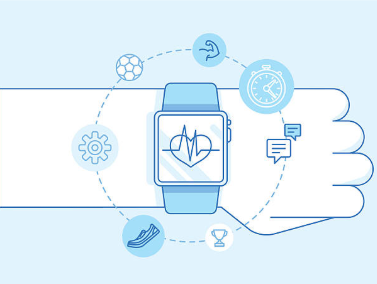
Recently, wearable health technology has become an effective mode of providing preventive healthcare. For one, these devices are able to track health conditions, early detection of certain diseases, and personalized interventions while more thoroughly educating individuals on the importance of maintaining their healthy daily habits. As they become more widespread in healthcare, wearables are shaping how both clinicians and patients approach long-term health management. Because preventive care requires continuous data for comprehensive results, wearable health technology provides exactly that by making health monitoring accessible and convenient for everyone.
One benefit of wearable devices is their tracking of physical activity. A report showed that trackers improved physical activity by around “1,800 extra steps per day, 40 minutes more daily walking, and approximately a one kilogram reduction in bodyweight” (Ferguson et al.). Clearly, wearables are more than just accessories. Instead, they produce significant changes with the potential to influence cardiovascular health and overall fitness. Additionally, economic evidence supports the scope of impact that wearable technology has on health outcomes. An economic report found that the “pedometer scenario could lead to significant gains in life years and QALYs,” with an incremental cost of “around 11,100 euros per QALY gained” (Velasquez et al.). The economics prove that increased physical activity is a cost-saver for patients and the healthcare system in the long run.
Nevertheless, it’s also important to note the gap between patients’ willingness to share their personal health data and the clinical integration of that data. For example, survey findings indicate that 78.4 percent of users stated that they were willing to share wearable data with clinicians, while only 26.5 percent actually had (Chandrasekaran et al.). This contrast reveals a structural problem: users want to contribute their data, but healthcare systems do not yet have easy mechanisms for information transmission. Thus, without sufficient privacy guarantees, it is difficult for clinicians to incorporate personal health data into critical treatment decisions. However, these barriers can be overcome by incorporating them into healthcare settings, resulting in improved patient outcomes and better usage of data from wearables. It also shows that the barriers are solvable and that successful integration has real consequences for preventive care.
Wearable technologies are increasingly utilized for the early identification of health decline. Smartwatches with electrocardiograms (ECGs) have been able to detect cardiac abnormalities. These devices can also constantly track respiration throughout an individual’s daily routine, offering “a significant advancement, enabling early detection of adverse health events while allowing patient mobility” (Velasquez et al.). This shows that wearable devices can identify clinically relevant issues in the course of everyday activities instead of waiting for an annual medical examination. Thus, the benefits of shifting from reactive crisis management to early intervention with health wearables lead to lower healthcare costs and better patient outcomes.
The best next step is for device companies to produce affordable health technology that all individuals, regardless of socioeconomic status, can access to ultimately promote overcoming health inequities. Another crucial improvement would be to expand the functions of wearable devices to cover a wider variety of health conditions, such as blood glucose monitoring, infection and inflammation detection, and mental health tracking. Overall, the future of preventive healthcare relies on the continuous advancements in accessibility, equity, and clinical integration through wearable healthcare devices.
Works Cited:
De Sario Velasquez, Gioacchino D. “Economic Perspective of the Use of Wearables in Health Care: A Systematic Review.” Science Direct, Elsevier, September 2024, https://www.sciencedirect.com/science/article/pii/S2949761224000385.
Ferguson, Ty. “Effectiveness of wearable activity trackers to increase physical activity and improve health: a systematic review of systematic reviews and meta-analyses.” The Lancet, Elsevier, August 2022, https://www.thelancet.com/journals/landig/article/PIIS2589-75002200111-X/fulltext.
Friend, Stephen H. “Wearable Digital Health Technology.” The New England Journal of Medicine, Massachusetts Medical Society, November 2023, https://www.nejm.org/doi/full/10.1056/NEJMe2303219.
“Usage Trends and Data Sharing Practices of Healthcare Wearable Devices Among US Adults: Cross-Sectional Study.” Journal of Medical Internet Research, 21 February 2025, https://www.jmir.org/2025/1/e63879. Accessed 17 November 2025.
Zhang, Hui, et al. The Impact of Wearable Technologies in Health Research: Scoping Review, https://pmc.ncbi.nlm.nih.gov/articles/PMC8826148/. Accessed 17 November 2025.
 Women, Cardiac Arrest, & the Simple Fix That Could Save Lives