
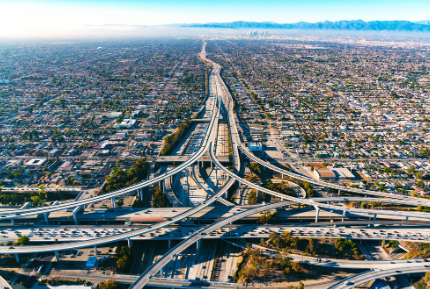
Big front lawns, endless traffic, nonexistent pedestrian infrastructure, and a plethora of parking lots. These are just some of the many characteristics of America’s sprawling suburban communities—communities not built around people, but around the automobile. As of 2025, Americans are extremely reliant on cars to get from one place to another. For the most part, automobiles are the only mode of transportation; however, it was not always like this. Up until the twentieth century, automobiles had not yet achieved their dominance. Major highways, roads and parking lots were nowhere to be seen. One of the most common forms of transportation in the United States was the train, as it was far superior to traveling by coach. It was not until the early twentieth century when the automobile became a major part of American life, driven by mass production and affordability. From that point on, highways were constructed, parking lots were paved and America’s vast railroad system was left in the dust. This major shift to a car-centric society in the United States has shaped the country we live in today, and we are only now realizing the consequences.
With the dominance of cars in the twentieth century, we began to shape our infrastructure around them. Among the Ford Motor Company, many other companies were created to take advantage of the surge in car use. One of these companies was National City Lines, a group that included several companies such as General Motors. National City Lines began buying public streetcar lines and replacing them with privately operated bus lines. This was one of the many actions that led to the deterioration of public transportation in America. By the mid-1900s, President Eisenhower signed the Interstate Highway Act, which created almost 50,000 miles of highway across the country. Meanwhile, public transportation was forgotten entirely and received virtually no funding. According to a HowStuffWorks article, the U.S. government would soon “be spending 75 percent of its transportation funding on building and repairing roads; less than one percent would be dedicated to mass transit for urban locations” (Fuller, 2023). With most people owning automobiles, it became possible to live outside of an urban setting and still work in a city. As a result, there was a surge in demand to move out of cities and into a much quieter, spacious living environment. Thus, the concept of suburbs was born.
Moving into the latter half of the twentieth century, detached homes were being mass-produced outside of cities. This completely changed the way people lived, creating a vastly different lifestyle from that of a city. People began to depend on their cars for everything, as public transportation was practically nonexistent, and walking and biking became impractical. In addition to civilians, businesses and manufacturing firms also began moving to the suburbs. Subsequently, the large shopping complexes and strip malls with endless parking lots that we know today began to pop up. This means there was no mixed-use space–which is the concept of having residential, commercial and other types of zoning on the same block or building–in the suburbs. Instead, everything began to spread out, increasing car dependency not only for commuting but also for everyday activities. Since people needed a car for most things, the focus on pedestrian, biking and public transportation infrastructure dwindled. This leads to the present-day United States, where, in most cases, society has built its infrastructure around cars rather than actual people.
To start, when cars are the primary or sole mode of transportation, a lot of valuable space is wasted. Not only do automobiles take up a lot of space themselves, but also the required infrastructure for them does as well, including vast parking lots, wide roads and endless highway interchanges. This is especially detrimental when cars are used for intercity travel, meaning that highways sometimes go through the hearts of big cities, taking up an enormous amount of space in downtown areas. The fact that cars occupy so much space raises questions about efficiency in how people get around. For example, especially when commuting, there is typically one person in each car, yet the car takes up far more space than one person needs. On the other hand, a singular train, bus or tram could carry the same number of people as hundreds of cars would while using significantly less space.
The effects of the inefficiency of cars are most apparent in densely populated areas, such as New York City. For instance, in the numerous tunnels and bridges connecting New Jersey to New York City, it is rare to find no traffic. When traveling within, into or out of dense urban areas, cars are very inefficient. Alternatives such as traveling by train or bus would help immensely with this congestion issue. Apart from being a waste of space, car travel also takes a massive toll on the environment. According to the United States Environmental Protection Agency (EPA), “A typical passenger vehicle emits about 4.6 metric tons of carbon dioxide per year” (U.S. EPA, 2025). When multiplying this number by the millions of cars on the road every day, the seriousness of the situation becomes clear. Vehicle emissions are a major source of atmospheric carbon dioxide and thus contribute to global warming. Before even bringing up using electricity rather than fossil fuels, this issue can be tackled by utilizing public transport such as trains and buses once again, as they are far more efficient.
In the end, cars are not entirely detrimental. They have given the world a new form of transportation that had never been seen before. However, when the dependency on cars grows to the extent that they are the sole form of transportation available, problems arise. The least we can do is give people multiple options for transportation. While cars can certainly be useful in suburban areas, they do more harm than good in densely populated areas. Therefore, it is time we shift our focus back onto pedestrian and public transportation infrastructure.
Works Cited:
Antonelli, Tia. “Automobile Suburbs.” Encyclopedia of Greater Philadelphia, Jan. 2024, philadelphiaencyclopedia.org/essays/automobile-suburbs.
Fuller, John. “Why Did Cars Become the Dominant Form of Transportation in the United States?” HowStuffWorks, 8 Mar. 2023, auto.howstuffworks.com/cars-dominant-form-transportation.htm.
| “Greenhouse Gas Emissions From a Typical Passenger Vehicle | US EPA.” US EPA, 12 June 2025, www.epa.gov/greenvehicles/greenhouse-gas-emissions-typical-passenger-vehicle. |
Milman, Oliver. “How Extreme Car Dependency Is Driving Americans to Unhappiness.” The Guardian, 31 Dec. 2024, www.theguardian.com/us-news/2024/dec/29/extreme-car-dependency-unhappiness-americans.
Wesseler, Sarah, and Sarah Wesseler. “American Society Wasn’t Always so Car-centric. Our Future Doesn’t Have to Be, Either.” Yale Climate Connections, 3 Oct. 2023, yaleclimateconnections.org/2023/10/american-society-wasnt-always-so-car-centric-our-future-doesnt-have-to-be-either.
 Sports Injury and Medical Innovation