
As of now, it’s unknown whether or not life exists outside of Earth. In recent years, astronomers have constantly been searching the observable universe for signs of life, and while intriguing observations are made once in a while, they have all been debunked in some way or another as just the result of some natural phenomenon, making it unclear if extraterrestrial life actually exists at all. This ambiguity, however, has not stopped people from trying to contact extraterrestrial life. While some have tried to locate alien life by combing through observatory and satellite data or analyzing the conditions of other star systems for habitability, others have tried reaching out directly to whomever may receive their messages. While many forms of communication intended to reach recipients on a human timescale have been used, a more unique message has also been sent—and it’s set to meet its receivers long after modern-day humanity’s earthly presence fades to ashes.
In the 1960s, the Voyager Program was conceived by the National Aeronautics and Space Administration (NASA) to launch spacecraft for data collection for invaluable research on Pluto and the four outer planets of the solar system: Jupiter, Saturn, Uranus, and Neptune. As part of the mission, identical spacecraft Voyagers 1 and 2 were built, and a precise route was drafted between the gas and ice giants. To ensure the spacecraft could travel at high speeds and cover billions of miles with minimal fuel usage, their paths were planned so they could use gravitational assists, the phenomenon of the gravitational force of one or more massive objects flinging a lighter object that was passing by, from large planets. Following the mission’s planning phase, Voyager 2 was the first to launch on August 20, 1977, from Cape Canaveral, Florida. Voyager 1 started its expedition on September 5 of that year from the same location on a faster trajectory than its counterpart.
After they were done with observations, NASA planned to send the Voyagers to interstellar space, the universe outside the area of influence of the Sun’s emissions (the heliosphere), on slow journeys as they eventually exhaust their fuel. By doing this, NASA was easily able to dispose of the probes while collecting data on interstellar space for the first time in human history. (The voyagers were projected to reach interstellar space faster than any other manmade space object because of their speed.) Being aware of the probes’ shared fate, a team led by Dr. Carl Sagan, including his wife, colleagues and friends decided to create something symbolic of the satellites’ manufacturers for each one to carry to whoever may find it.
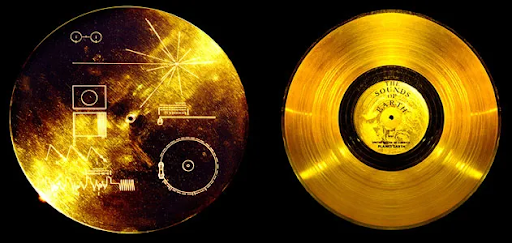
On each of the Voyager spacecraft are two identical phonograph records encased in aluminum, one on the side of each probe. The disks are each plated with gold giving them their iconic name: the Golden Records. With the records, Sagan’s team wanted to show the likeness of humanity to extraterrestrial recipients.
Sagan’s team knew there would be many challenges in effectively creating a time capsule of an entire species including universality, defined as the ability to ensure that the records contain information decipherable to anyone. The group was aware that exclusively human units couldn’t be used to communicate the records’ information effectively. To establish a timescale to use for written time signatures of the record, there is a depiction of a transition between hydrogen’s two lowest states with a one near it. This drawing clarifies that all the text on the disk is in binary arithmetic in terms of fundamental hydrogen transition and should be used as a unit of time when analyzing the disks’ contents. To further help achieve universality, each record also contains an ultra-pure sample of uranium-238 on its cover. Because uranium is radioactive, it decays over time into various stable daughter isotopes. Using this knowledge, technologically-advanced receivers could find the ratio between the uranium-238 and its daughter isotopes to calculate the approximate time the Voyagers were launched.
On Side One of each disk is the phrase, “The Sounds of Earth,” and the name of NASA and its location in “The United States of America: Planet Earth,” written in English. On Side Two are various images communicating how to use a phonograph. The upper left-hand area of each disk has a drawing of the record with a stylus positioned to play the record from the beginning. Written near it is the time a full rotation of the disk takes, 3.6 seconds, in binary arithmetic. Below that drawing is another illustration of the disk being played from a side view with an indication of the runtime of each side of the record, around an hour. On the top-right of each disk are illustrations demonstrating how signals are used to construct pictures. Below those diagrams is a drawing of the first picture on the record for recipients to use to ensure they’re using the phonograph correctly. The largest drawing on each Golden Record’s cover is a pulsar map located on the bottom left of the disk. The map depicts fourteen pulsars, neutron stars rotating fast enough to send beams of electromagnetic radiation from their poles, with axes facing the Earth to give an idea of the location of the planet in the universe.
The actual contents the Golden Records carry, known as the Voyager Message, features various visual and auditory elements of the Earth and humanity. Because Sagan’s team wanted to ensure that the curation included all of the defining traits of humanity while depicting it in a positive and inclusive light, themes of war, violence, politics and religion were avoided when compiling the message’s contents.
The crew’s final product starts with the exhibition of 115 images. Among the images are guides to human notations of numbers and chemistry. Along with those are depictions of human anatomy along with illustrations of various animals and a world map. Iconic human creations and activities are also featured. After the images, there is a ninety-minute assortment of music including various cultural and popular songs throughout human history followed by various sounds from the natural world and human machinery are played. Wrapping up the message are greetings in 55 different languages sorted by alphabetical order starting from Akkadian, an ancient Sumerian language, and ending in Wu, a dialect of modern Chinese.
As of February 2024, both Voyagers 1 and 2 have exited the heliosphere. Voyager 1 crossed the heliopause (the boundary of the heliosphere), in August 2012. It is currently the farthest human-made object away from Earth at a distance of approximately 15 billion miles away and the first to reach interstellar space. Voyager 2 reached the heliopause on November 5, 2018, and is currently 12 and a half billion miles away from Earth. Both probes still have some powered instruments sending back data to NASA, giving researchers insights on the conditions of the universe beyond the immediate solar system. The satellites travel through the vast abyss of interstellar space where even at the speed they’re traveling, they will only begin to pass by other star systems around 40,000 years from now. With them, the Voyagers not only carry humanity’s time capsule and mark on the universe, but also its hopes, dreams, and stories as grand as the stars themselves.
Mathematically speaking, it’s highly likely that the carriers of the Golden Records may wander through interstellar space for eternity without seeing a civilization other than that of its creators. Instertellar space is simply so vast that the distances between stars is so immense, and even if the Voyagers enter other star systems, they may not pass by planets close enough to be observed by intelligent life forms residing on them. However, the Golden Records still serve an important purpose, even if their disks’ contents are never viewed. The Voyager Message’s existence in itself immortalizes the works and likeness of people who may become long forgotten in the far future and preserves the tale of people living in a world vastly different than the one humanity knows today. Most of all, the Voyagers serve as a testament to the existence of an intelligent and social species with a hunger for interaction even in the expansive, silent void of space.
Works Cited:
Calla Cofield. “What Are Pulsars?” Space.com, Imaginova Corporation, 22 Apr. 2016, www.space.com/32661-pulsars.html. Accessed 18 Feb. 2024.
Centers for Disease Control and Prevention. “Radiation Studies - CDC: Properties of Radioactive Isotopes.” Www.cdc.gov, 25 Feb. 2019, www.cdc.gov/nceh/radiation/isotopes.html#:~:text=Half%2Dlife%20is%20the%20length. Accessed 18 Feb. 2024.
Gambino, Megan. “What Is on Voyager’s Golden Record?” Smithsonian Magazine, Smithsonian Institution, 22 Apr. 2012, www.smithsonianmag.com/science-nature/what-is-on-voyagers-golden-record-73063839/. Accessed 18 Feb. 2024.
Howell, Elizabeth. “Voyager Spacecraft: Beyond the Solar System.” Space.com, Imaginova Corporation, 28 Feb. 2018, www.space.com/17205-voyager-spacecraft.html. Accessed 18 Feb. 2024.
Marshall, J. “Sides 1 and 2 of One of the Golden Records.” Smithsonian Magazine, Photography, www.smithsonianmag.com/science-nature/what-is-on-voyagers-golden-record-73063839/. Accessed 19 Feb. 2024.
National Aeronautics and Space Administration. “A Gravity Assist Primer - NASA Science.” Science.nasa.gov, NASA, science.nasa.gov/learn/basics-of-space-flight/primer/. Accessed 18 Feb. 2024.
National Aeronautics and Space Administration. “Voyager - Mission Overview.” Nasa.gov, NASA, 2012, voyager.jpl.nasa.gov/mission/. Accessed 18 Feb. 2024.
National Aeronautics and Space Administration. “Voyager - the Golden Record.” Nasa.gov, NASA, 2019, voyager.jpl.nasa.gov/golden-record/. Accessed 18 Feb. 2024.
National Aeronautics and Space Administration. “Voyager - What’s on the Golden Record.” Nasa.gov, NASA, 2019, voyager.jpl.nasa.gov/golden-record/whats-on-the-record/. Accessed 18 Feb. 2024.
| National Aeronautics and Space Administration “Where Do Old Satellites Go When They Die? | NASA Space Place – NASA Science for Kids.” Nasa.gov, NASA, 2019, spaceplace.nasa.gov/spacecraft-graveyard/en/. Accessed 18 Feb. 2024. |
| National Air and Space Museum. “Voyager Spacecraft | National Air and Space Museum.” Airandspace.si.edu, Smithsonian Institution, airandspace.si.edu/collection-objects/voyager-spacecraft-mock-full-scale/nasm_A19772728000. Accessed 18 Feb. 2024. |
Sagan, Carl. Murmurs of Earth: The Voyager Interstellar Record. Random House, 1978.
| The Editors of Encyclopaedia Britannica. “Voyager | Definition, Discoveries, & Facts.” Encyclopædia Britannica, Encyclopædia Britannica, Inc., 2019, www.britannica.com/technology/Voyager-space-probes. Encyclopædia Britannica. Accessed 18 Feb. 2024. |
The Planetary Society. “The Voyager Missions.” The Planetary Society, www.planetary.org/space-missions/voyager. Accessed 18 Feb. 2024.
 An Inside View of Girls with Leadership Roles